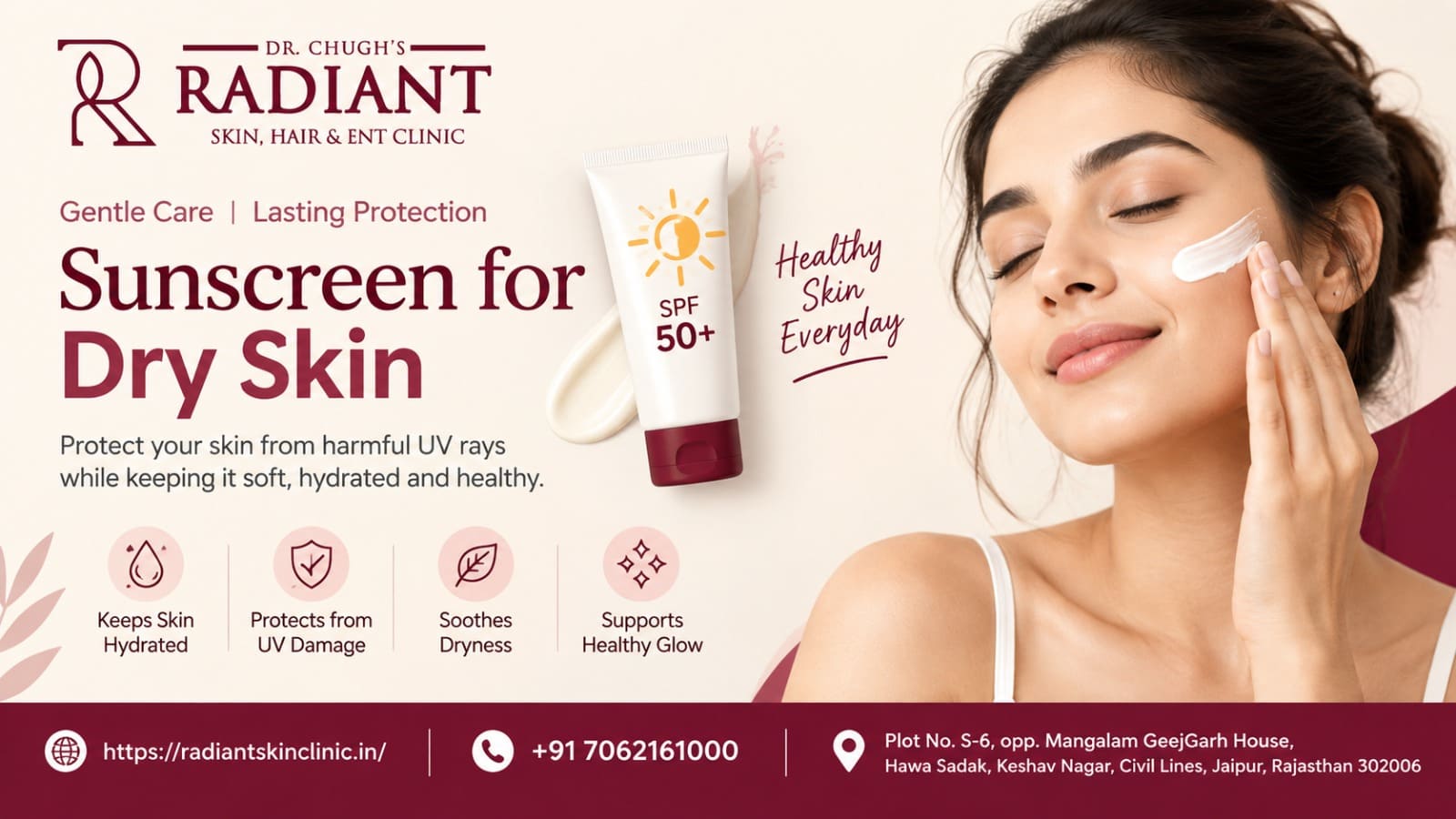
Sunscreen is an essential part of everyday skincare, regardless of your skin type. However, people with dry skin often need to think beyond sun protection. Some sunscreen formulas can leave the skin feeling tight, flaky, or uncomfortable, while the right product can provide both UV protection and hydration.
Choosing the right Sunscreen for Dry Skin means looking for a formula that supports the skin barrier, feels comfortable throughout the day, and provides adequate broad-spectrum protection. Ingredients, texture, SPF, and application technique all matter when selecting a sunscreen for dry skin.
If you are unsure which sunscreen is appropriate for your skin, a consultation with a Dermatologist in Jaipur can help you understand your skin type and choose products according to your individual needs.
Key Ingredients Dry Skin Should Look For in Sunscreens
When choosing a good sunscreen for dry skin, look for formulas that combine sun protection with moisturising and barrier-supporting ingredients.
1. Hyaluronic Acid
Hyaluronic acid is a humectant that helps attract and retain water in the skin. It can make sunscreen more comfortable for people who experience dryness or dehydration.
2. Glycerin
Glycerin is another humectant commonly found in moisturising skincare products. It helps attract moisture and can leave the skin feeling softer and more comfortable.
3. Ceramides
Ceramides are naturally occurring lipids that play an important role in maintaining the skin barrier. Sunscreens containing ceramides may be particularly useful for people whose dry skin is also prone to sensitivity or barrier disruption.
4. Squalane
Squalane is an emollient that can help soften the skin and reduce the uncomfortable feeling of dryness. It can work well in sunscreen formulas designed for dry or normal-to-dry skin.
5. Niacinamide
Niacinamide is a versatile skincare ingredient that can support the skin barrier and is included in some sunscreen formulations. It may be useful when dryness is accompanied by sensitivity or uneven skin tone.
6. Moisturising Oils and Emollients
Certain lightweight oils and emollients can help provide a smoother, more comfortable finish. However, the ideal formulation depends on individual skin type and sensitivity.
When selecting a sunscreen, consider the complete formulation rather than relying on a single ingredient.
Ingredients to Avoid in Sunscreens for Dry Skin
Not every sunscreen will feel comfortable on dry skin. Some formulas may increase the feeling of tightness or irritation, particularly when the skin barrier is already compromised.
Depending on your individual sensitivity, you may want to be cautious with:
- High concentrations of drying alcohols
- Strong fragrances
- Excessively mattifying ingredients
- Very astringent formulas
- Products that leave a strong powdery finish
This does not mean every product containing these ingredients is unsuitable for everyone. Skin tolerance varies, so it is important to consider how your skin actually responds.
If your skin frequently becomes red, itchy, flaky, or irritated after applying sunscreen, consider discussing your routine with a dermatologist.
Best Sunscreen for Dry Skin Dermatologist Recommended
There is no single sunscreen that is universally the best sunscreen for dry skin. The ideal choice depends on your skin type, sensitivity, lifestyle, level of sun exposure, and other skincare products you use.
For dry skin, a sunscreen with a moisturising or cream-based texture may be more comfortable than an extremely lightweight, alcohol-heavy or highly mattifying formula.
When choosing a sunscreen, consider the following:
- Broad-spectrum UVA and UVB protection
- SPF 30 or higher for everyday use
- Moisturising ingredients
- Comfortable texture
- Suitable for your skin sensitivity
- Water resistance when required
- Minimal irritation
If you have persistent dryness, eczema-prone skin, acne alongside dryness, or frequent irritation, a personalised recommendation from a Best Dermatologist in Jaipur can help you avoid unnecessary trial and error.
At Radiant Skin & ENT Clinic, a dermatologist can assess your skin and help you understand which type of sunscreen and skincare routine may be appropriate for your individual needs.
The Correct Sunscreen Vehicle (Cream vs. Gel/Spray)
The texture or “vehicle” of a sunscreen affects how it feels on the skin and how likely you are to use it consistently.
Cream Sunscreen
Cream-based sunscreens are often a comfortable option for dry skin because they can provide a moisturising feel while delivering UV protection.
They may be particularly suitable for:
- Dry skin
- Mature skin
- Normal-to-dry skin
- Skin that feels tight after cleansing
- People who prefer a moisturising finish
Gel Sunscreen
Gel formulas are generally lightweight and may be more comfortable for oily or acne-prone skin. However, some gel sunscreens can feel less moisturising on very dry skin.
If you have combination skin with dry cheeks and an oily T-zone, a lightweight cream or lotion may offer a useful middle ground.
Spray Sunscreen
Spray sunscreens can be convenient for the body and for reapplication. However, it can be difficult to ensure adequate coverage if the product is sprayed directly and thinly onto the skin.
For the face, applying an appropriate amount carefully is generally more reliable than simply spraying and assuming the entire area is covered.
The best vehicle is ultimately the one that provides adequate protection and feels comfortable enough for you to use consistently.
Understanding SPF Levels for Dry Skin
SPF measures protection against UVB radiation, which is a major contributor to sunburn. Your skin type does not change the meaning of SPF, so dry skin does not require a different SPF scale from oily or combination skin.
For everyday use, many dermatology organisations recommend using a broad-spectrum sunscreen with SPF 30 or higher.
Broad-spectrum protection is important because it covers both UVA and UVB radiation.
Higher SPF values can provide greater UVB protection when applied correctly, but SPF alone is not enough. Application amount, reapplication, shade, protective clothing, and avoiding intense midday exposure can all contribute to better sun protection.
Remember that sunscreen does not provide unlimited protection. It needs to be reapplied, particularly after sweating, swimming, or prolonged outdoor exposure.
How to Apply Sunscreen on Dry Skin for Best Results
Even a high-quality Sunscreen for Dry Skin will not work as intended if it is not applied properly.
Step 1: Start With Gentle Cleansing
Use a gentle cleanser that does not leave your skin feeling excessively tight or dry after washing.
Step 2: Moisturise
If your sunscreen is not sufficiently moisturising, apply a suitable moisturiser first. Allow it to settle for a short time before applying sunscreen.
People with very dry skin may benefit from a richer moisturiser, while those with mildly dry skin may prefer a lightweight lotion.
Step 3: Apply Enough Sunscreen
Use an adequate amount to cover all exposed areas. For the face, a commonly used practical guide is approximately two finger lengths of sunscreen for the face and neck, although the amount needed can vary depending on the product and area being covered.
Don’t forget commonly missed areas such as:
- Ears
- Neck
- Hairline
- Around the jaw
- Back of the hands
Step 4: Apply Before Sun Exposure
Apply sunscreen before going outdoors so that the product has time to form an even protective layer.
Step 5: Reapply
Reapply regularly when spending extended periods outdoors, particularly after swimming, sweating, or towel drying.
For people who work indoors but sit near windows or frequently travel outdoors, daily sunscreen can still be an important part of a consistent skincare routine.
Conclusion
Choosing the right Sunscreen for Dry Skin involves more than simply checking the SPF number. A good formula should provide broad-spectrum UV protection while also feeling comfortable and supporting the skin’s moisture barrier.
Look for hydrating ingredients such as glycerin, hyaluronic acid, ceramides, and suitable emollients. Cream or lotion-based formulas may feel more comfortable for very dry skin, while lighter textures may suit people with combination skin.
Most importantly, choose a sunscreen that you can apply generously and consistently. If you experience persistent dryness, irritation, or difficulty finding suitable skincare products, consulting a Dermatologist in Jaipur can help you develop a routine suited to your skin.
FAQs
1. Which sunscreen is best for dry skin?
A sunscreen with broad-spectrum SPF 30 or higher and moisturising ingredients can be a good option for dry skin. Cream or lotion-based formulas are often more comfortable than highly mattifying products.
2. Can I use sunscreen without moisturiser on dry skin?
Yes, if your sunscreen contains sufficient moisturising ingredients and feels comfortable on your skin. If your skin still feels tight or flaky, applying a moisturiser before sunscreen may help.
3. Is SPF 50 better for dry skin?
SPF 50 can provide a high level of UVB protection, but SPF does not depend on whether your skin is dry or oily. Proper application and reapplication are equally important.
4. Should dry skin use gel sunscreen?
Dry skin can use gel sunscreen, but some gel formulas may feel less moisturising. If your skin feels tight after application, a cream or lotion-based sunscreen may be more comfortable.
5. Can sunscreen make dry skin worse?
Some formulations may make dry skin feel tighter or more irritated, particularly if they are highly mattifying or contain ingredients that your skin does not tolerate. Choosing a moisturising formulation can improve comfort.
6. When should I consult a dermatologist for dry skin?
If dryness is persistent, accompanied by redness, itching, cracking, irritation, or recurring rashes, consider consulting a dermatologist. A Best Dermatologist in Jaipur can assess your skin and recommend a suitable skincare and sun-protection routine.