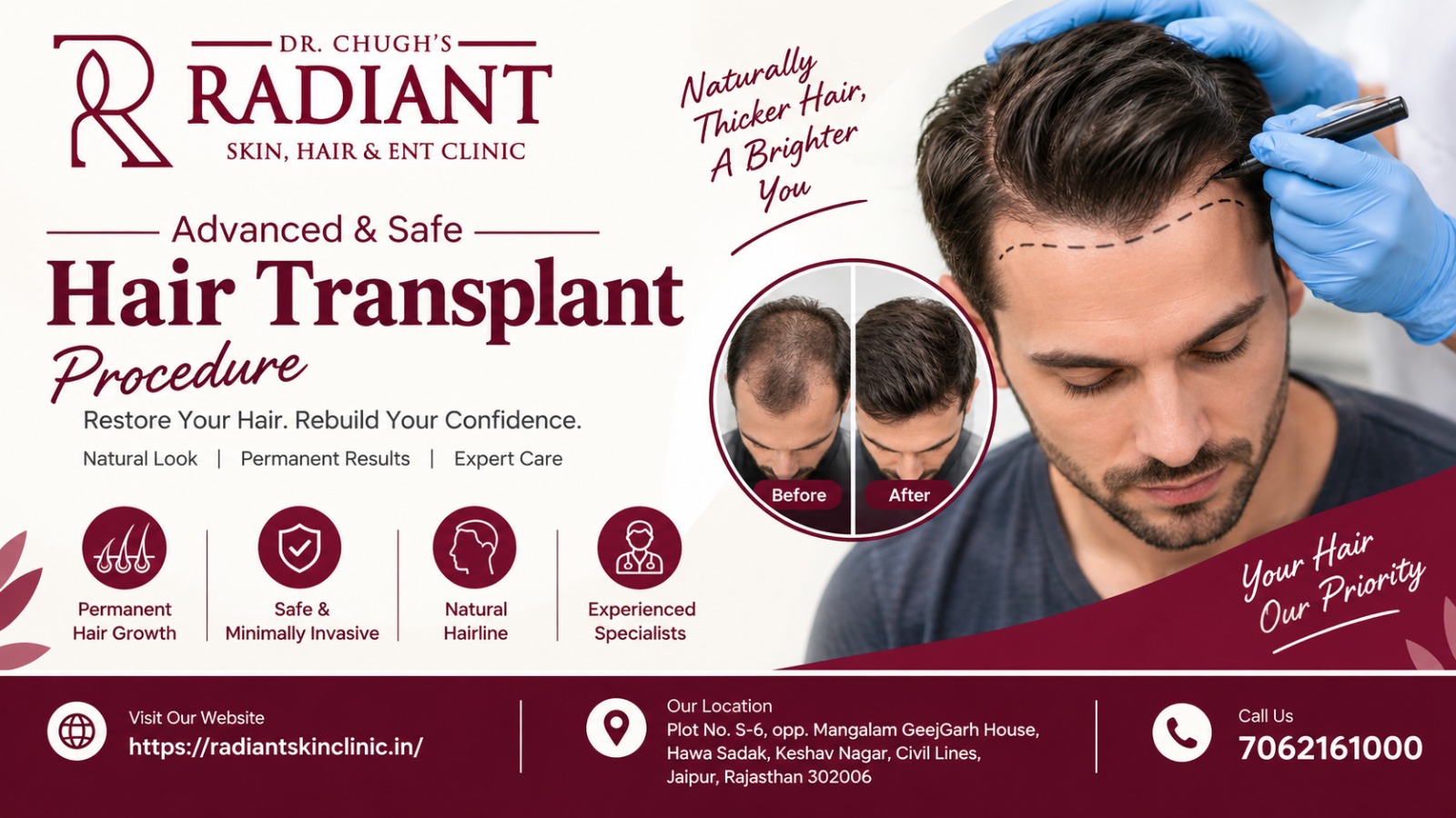
The preparation, local anesthesia, extraction of hair using the FUE or FUT methods, micro dissection, creation of slits, and graft placement according to patient needs is all part of the hair transplant procedure. The process, at clinics like Radiant Skin & ENT Clinic, can take 4 to 8 hours, and you can get back to your normal routine in no time.
It can be scary to lose hair, but it’s even more scary to not know what you’re in for when you commit to treatment. Researching the stages of hair transplant procedure can help alleviate concerns and make this all less daunting for potential patients.
Here, we show you each of the stages of hair transplant procedure in the order that they happen to lessen the confusion surrounding hair loss treatment in Jaipur and help you better understand the modern techniques of hair restoration.
List of steps in a hair transplant surgery
A hair transplant surgery cannot be done all in one go. It is a series of steps that all have to be done to help provide the best possible results. Each step has a purpose in creating a natural and permanent hair transplant.
Preparation for hair transplant surgery
There are several steps that have to be taken before any surgery can be done. The surgeon evaluates the hair loss and baldness of the patient. For the skin clinic in Jaipur, this includes a complete examination of the patient’s hair and scalp along with a full explanation of the patient’s history.
You’ll be told not to take blood thinners, drink, or smoke for a week to two weeks before surgery. Your scalp will be washed with a special shampoo the day of the surgery to lessen the chances of infection.
Local Anesthesia
Hair transplantation surgery is done under local anesthesia. This means the surgery area will be numbed, but you will be awake for the entire duration of the surgery.
The surgeon will administer local anesthesia into both the back of the scalp (donor area) as well as the recipient area. Local anesthesia ensures a better, safer surgery, and most importantly, a faster recovery as compared to general anesthesia.
Remove Hair Follicles
The hair transplant procedure involves taking the hair follicles from the donor area and placing them into the recipient area. There are two main methods of doing this:
Follicular Unit Extraction (FUE): This is done by removing individual hair follicles via a small, specialized punch tool. This is a common procedure for patients who want to keep their hair short because it leaves no scarring.
Follicular Unit Transplantation (FUT): This is done by surgically removing a strip of scalp from the donor area. Afterwards, an individual follicle is isolated from the strip of scalp under a microscope.
Hair Roots Extracted Using the FUT Technique
After removing the Donor Strip in FUT, it is then sectioned and follicular units are extracted under magnification after which they are separated.
It yields better grafts and is ideal in patients with extensive hair loss as more coverage is required.
Suturing of the Donor Area
After a strip is removed in FUT, the surgery is not complete without closure. In such cases, the surgeon uses a trichophytic closure method which is an advanced technique in which the scar is made to be covered with hair resulting in an almost invisible scar.
The donor area needs a closure and the sutures are removed 10-14 days later. During this time the scar markedly improves.
Microscopic Dissection
Tissue, once extracted, is now viewed under a microscope and separated into individual follicular units at this stage. It is important to keep each unit intact and preserve the number of hairs to one to four.
This is perhaps the most important and most difficult stage of the surgery as it is concerned with the preservation of the tissue.
Slit Creation
Slit creation can help the surgeon make small incisions in the area on the recipient site to better place hairs in their natural growing pattern of the scalp. The surgeon determines the angle, the depth, and the direction of each small incision made.
This step is extremely important to obtain natural looking results. Because properly created slits help hair to grow in the desired direction. So, this step requires great skill and experience.
Placement of Grafts/Follicular Units
Once slits are ready, the surgical team places each follicular unit graft in its corresponding slit. This part of the surgery is very slow and time-consuming, often taking several hours to complete, depending on the number of grafts to be transplanted.
Grafts must be placed with the utmost care to ensure intactness and avoid breakage, since their survival is tied to how long they are in contact with the air and how much they are traumatized during the surgery.
Varying Graft Density
Not all parts of the scalp require the same level of grafting. Surgeons vary the density to mimic the inherent variations in natural hair density. It is most apparent at the frontal hairline, where the scalp appears fuller, but is less apparent at the crown of the head.
This approach, talked about by many experts such as Radiant Skin & ENT Clinic, helps to achieve a natural looking appearance, in contrast to poorly done transplants that appear very unnatural.
After Hair Transplant Surgery
Once grafts are placed, the doctor completes a final check of the scalp, to ensure that the grafts are in the right spots, and that the scalp is sufficiently covered. Post care instructions are provided to patients, to inform them on how to take care of their scalp, what medications to take, what to look out for, and how to identify complications.
While redness, swelling, scabbing, and tenderness around the transplanted region is expected for about a week to 10 days, these symptoms should subside after a few days of the surgery.
Closing of the Procedure
Before you leave the clinic, the doctor checks the recipient and donor areas one last time. The scalp is protected with a bandage or light dressing. A follow up appointment is scheduled to check the rate of healing.
Most clinics, such as Radiant Skin & ENT Clinic, schedule a follow up appointment for the first week after surgery, to assess the early stages of healing, and answer any concerns the patient may have.
Resuming of Regular Schedule
A minimum of 2-3 days after surgery is needed for most patients to return to normal, less active work. For the first 2-3 weeks after surgery, avoid swimming and strenuous exercises, as well as direct sunlight exposure.
New Hair growth usually occurs at 3-4 months after surgery. Fuller hair growth typically occurs at 8-12 months.
Understanding the Stages of Hair Transplants
The hair transplant procedure is quite involved and knowing each stage helps develop realistic expectations on recovery time and surgical results. The stages of the process cover everything from anesthesia to graft implantation. In general, selecting a good clinic is just as important as understanding the process.
If you are researching hair transplant in Jaipur, you should schedule a consultation with a specialist to identify your unique pattern of hair loss and determine the best available course of treatment. A consultation is the next step in making informed decisions related to treatments.
How long does a hair transplant take?
Between 4-8 hours is average. Time can vary depending on the number of grafts needed and the technique used, whether it’s FUE or FUT.
Is a hair transplant painful?
Since local anesthesia is used, patients do not feel pain during surgery. Mild discomfort or tenderness for a short period after the operation is to be expected and can be treated with pain meds that were prescribed.
What is the difference between FUE and FUT hair transplant techniques?
With FUE, the individual follicles are removed from the scalp, and since FUT is done by the removal of a strip of scalp and dissection into grafts, it yields many more grafts during a single session, but leaves a linear scar.
When can I expect to see results from my hair transplant?
Initial growth is evident between 3 and 4 months after surgery. More noticeable results can be seen after 8-12 months as the hair grows and matures.
Are there potential problems from getting a hair transplant?
With any surgical procedure, there are risks that include infection, scarring, and graft failure. These are significantly reduced by picking a skilled hair restoration surgeon and following the post-surgical instructions.
Who is an ideal candidate for a hair transplant?
The best candidates for hair transplant are patients with stable hair loss patterns and sufficient donor hair density. To determine if a patient is an ideal candidate for surgical hair restoration and transplant, a patient needs to consult a hair transplant specialist, such as Radiant Skin & ENT Clinic.